
Three things to know
- Dilatation opens a narrowing. Treatment of reflux or EoE with medicines may still be needed.
- Some people also benefit from assessment by a dietitian or speech-language therapist for nutrition or swallowing support.
- More than one session may be needed. Your response and the narrowing guide the next step.
Watch the journey
Watch: oesophageal dilatation
1:39 · English narration and captions
Why dilatation is offered, how balloon and wire-guided treatment work, repeat treatment and recovery.
Captions are included in the film. Your own preparation, consent discussion and aftercare instructions take priority.
Skip to a section
Read the transcript
0:00 Why food catches
A narrowed food pipe can make food catch. Dilatation widens that area to help swallowing.
0:07 Different causes
The cause may be reflux scarring, a thin ring, EoE or a surgical join. Examination and biopsies help establish the cause.
0:16 Before treatment
Follow the instructions provided about fasting and medicines. The expected benefit, risks and alternatives are discussed before treatment.
0:25 Balloon dilatation
A balloon passes through the gastroscope and is positioned across the narrowing. It expands to a selected size, then is deflated and removed.
0:35 Wire-guided Savary dilatation
Another option uses a smooth, tapered dilator over a guidewire. It widens the narrowing as it passes through. It does not inflate or stay inside.
0:46 Improvement and repeat treatment
The aim is easier swallowing. Some narrowings need several sessions, or tighten again. Treatment of reflux or EoE with medicines may still be needed.
0:57 Extra support with eating
Some people also benefit from assessment by a dietitian or speech-language therapist for nutrition or swallowing support.
1:05 Risks and treatment
Risks include pain, bleeding and sedation problems. Significant perforation is relatively uncommon but can be serious. It may need hospital care, endoscopic treatment or surgery.
1:18 Recovery
Follow your own eating, medicine and sedation instructions. The team checks your recovery before discharge and explains follow-up.
1:26 When to get help
Persistent pain, fever, breathlessness, bleeding or difficulty swallowing fluids need urgent assessment. Call one-one-one if severely unwell.
When might dilatation help?
A narrowing may be described as a stricture or stenosis. You may notice solid food catching, need to chew for longer, avoid certain foods or rely on softer meals. Dilatation can make eating easier and reduce food sticking when a narrowing is responsible.
Difficulty swallowing needs assessment. I do not assume it is simply reflux or normal ageing. Gastroscopy lets me examine the lining and take biopsies to check for inflammation, EoE and cancer. A tight or unusual narrowing may need biopsy results or further imaging before treatment.
If the food pipe is not narrowed, stretching it may not address the problem. Persistent symptoms can need tests of how its muscles work. Difficulty starting a swallow, coughing or choking may need a different swallowing assessment.
Different narrowings need different treatment
These examples show different patterns, not stages that everyone passes through. Their appearance alone does not establish the diagnosis. Biopsies and your history help distinguish them.
Reflux-related stricture
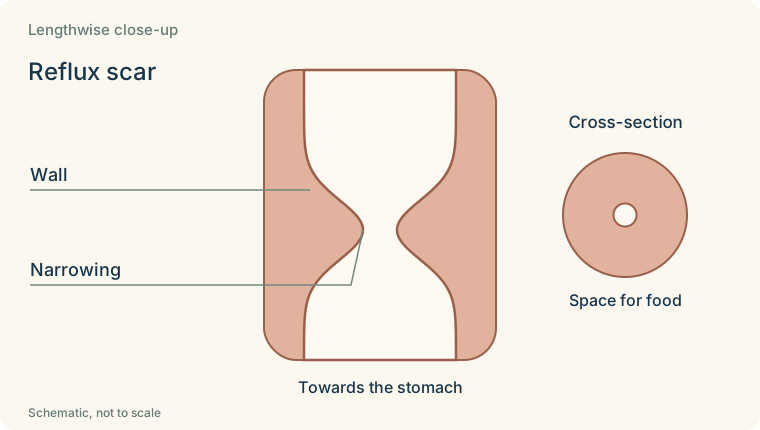
Repeated acid-related injury can heal with scar tissue, often near the lower end of the food pipe. Dilatation treats the narrowing. Acid-suppressing treatment helps control the ongoing reflux injury and reduce recurrence.
Schatzki ring or web
A thin ring near the junction with the stomach can cause intermittent food sticking. A web is a thin membrane, usually higher up. A symptomatic ring or web may be widened; an incidental finding without swallowing symptoms does not automatically need treatment.
Eosinophilic oesophagitis (EoE)
Inflammation can make the food pipe less stretchy, with rings, a short narrowing or a longer narrow segment. Dilatation treats established narrowing, but medicines or a supervised dietary treatment are still needed for the inflammation. EoE can also be present when the lining looks normal.
Scar at a surgical join
After surgery, scar tissue can narrow the join between two parts of the digestive tract. Balloon dilatation can be suitable. The operation, healing, shape and length of the narrowing affect the approach and whether several treatments are needed.
Other or more complex strictures
Radiotherapy, a previous caustic injury or some endoscopic treatments can leave longer or irregular scars. These may need additional imaging, more gradual treatment or a specialist service. Cancer can also cause narrowing and requires its own assessment and treatment plan.
Explore the illustrations
See how narrowings differ
Choose an example. The shapes illustrate different conditions, not a diagnosis or a sequence of disease stages.
Repeated acid-related injury can heal with scar tissue, often near the lower end of the food pipe. Dilatation treats the narrowing. Acid-suppressing treatment helps control the ongoing reflux injury and reduce recurrence.
Motion is reduced on your device. Use Next to explore each step.
Balloon or Savary: how I choose
I usually use a balloon, including for suitable postsurgical narrowings. For selected very tight or longer oesophageal narrowings, including some cases of EoE, I may use a wire-guided Savary-style dilator. Neither method is the best choice for every stricture. I consider its cause, position, length, tightness and the previous response.
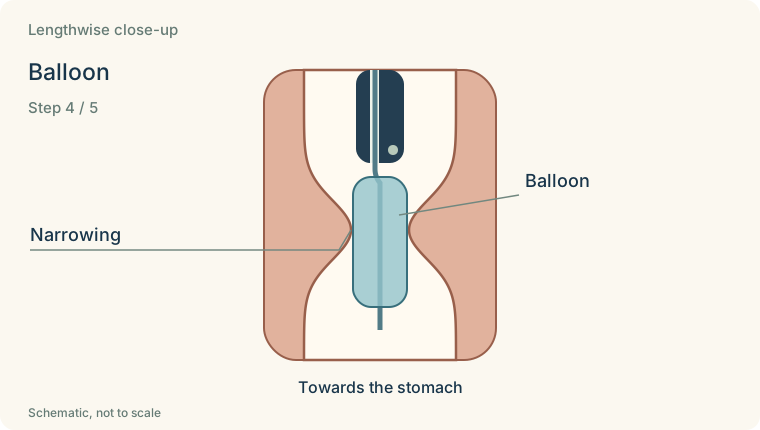
With a through-the-scope balloon, a slim catheter passes through the gastroscope. The balloon is positioned across the narrowing, expanded to a selected size, then deflated and removed. Expansion applies pressure outwards at the narrowed area.
A Savary-Gilliard dilator is a smooth, tapered tube passed over a guidewire already positioned through the narrowing. The gastroscope is withdrawn while the wire stays in place. The dilator slides along the wire and widens the narrowed segment as its taper passes through. Selected sizes may be used in sequence. It does not inflate and is not left inside.
Savary-style devices belong to the bougie family. Other wire-guided bougie systems include the American Dilation System. Brand names describe equipment, not a different diagnosis. The animation explains the principle and is not a guide to performing the procedure.
Explore the illustrations
Compare the two methods
Step through each method, or play the sequence. The diagrams explain the principle; treatment size and timing are individual.
The narrowing is assessed.
Motion is reduced on your device. Use Next to explore each step.
What improvement can I expect?
The aim is to swallow more comfortably, have less food sticking and eat a wider range of foods. The amount and duration of improvement vary. Dilatation cannot guarantee completely normal swallowing, remove the underlying tendency to scar or correct every muscle problem.
At follow-up, I check which foods still catch, whether you can eat and drink enough, any weight change and how long the improvement lasted. Those details help decide whether another dilatation, a change in treatment or further investigation would be useful.
Why might I need more than one session?
A very tight or long narrowing may need to be opened in stages. Another session can be part of the original plan rather than a sign that treatment has failed. The interval and number are individual; there is no fixed course that suits everyone.
Scar tissue can also tighten again after an initial improvement. Treating reflux or EoE reduces continuing injury, but some strictures still recur. Contact me or your GP if swallowing deteriorates rather than waiting until food becomes completely stuck.
If repeated dilatation is not giving lasting benefit, I reassess the diagnosis, inflammation, nutrition and the pattern of scarring. Selected cases may need an injection into the scar, an endoscopic incision, a temporary stent or surgical advice. These have their own risks and are not routine additions for everyone.
Before and during the procedure
- Follow the fasting instructions from your endoscopy service. Tell the team if food remains stuck or you cannot manage fluids; you may need assessment before a routine appointment.
- Provide a complete medicine list, including blood thinners and diabetes medicines. Do not stop them yourself. If a medicine needs to be withheld, the instructions should specify when to stop and restart it. Contact the team if anything is unclear.
- Tell the team about previous food-pipe surgery, radiotherapy, a previous tear or perforation, allergies and earlier problems with sedation.
- We discuss the intended benefit, risks, alternatives and possibility of repeat treatment before consent. Sedation and pain relief are tailored to the procedure and your health.
- You are usually positioned on your left side. Breathing, oxygen level, pulse and blood pressure are monitored. The narrowing is assessed before the chosen treatment is carried out.
- If you receive sedation, arrange a responsible adult to take you home and follow the service's supervision and driving restrictions. Confirm the clinic location on the Contact page.
Risks and how they are managed
Dilatation is an established treatment, but stretching a narrowing has more risk than simply looking with a gastroscope. Your individual risk depends on the narrowing and the treatment needed.
Soreness or chest discomfort
A sore throat or discomfort on swallowing can occur, particularly after treatment of EoE. The team checks symptoms during recovery and advises on suitable pain relief. Persistent, severe or worsening pain needs urgent assessment, even if some discomfort was expected.
A surface split or bleeding
The lining may split as scar tissue stretches. A superficial split is different from a full-thickness perforation. Small amounts of bleeding may settle without further treatment. Significant bleeding may need endoscopic treatment, observation or hospital care.
Perforation
Significant perforation, where a tear extends through the wall, is relatively uncommon but can be serious. If suspected, urgent assessment and usually a CT scan are needed. Treatment can involve hospital admission, a period without food or drink, intravenous fluids and antibiotics. Depending on the tear, endoscopic clips or a covered stent may help seal it; drainage or surgery may be needed. Transfer to a hospital may be necessary.
Sedation or aspiration
Sedation can affect breathing, oxygen level or blood pressure. Stomach contents can occasionally enter the lungs. Fasting, assessment and monitoring reduce risk. If a problem occurs, the team supports breathing and circulation and arranges further treatment or observation.
Eating, medicines and recovery
The team checks that you are recovering appropriately and can manage fluids before discharge. Follow your own instructions about when to start drinking, which foods to choose and when to return to your usual diet. Do not test the result immediately with a large or difficult mouthful.
Continue prescribed treatment for reflux or EoE unless advised otherwise. Follow the individual restart instructions for any medicines that were withheld. Your endoscopy report, and histology report when biopsies return, document findings and recommended follow-up.
Use the procedure service's discharge contact for concerns after treatment. Consultation reception numbers are not a substitute for urgent assessment.
When to seek urgent help
After dilatation, seek urgent medical assessment for persistent or worsening chest, neck or upper tummy pain, fever, breathlessness, repeated vomiting, vomiting blood, black tarry poo or difficulty swallowing fluids. Tell the team you recently had oesophageal dilatation.
If food is stuck and you cannot swallow your saliva, go to an emergency department. Do not try to force it down with more food or drink.
Call 111 for severe chest pain, significant breathing difficulty, collapse, heavy bleeding or if you are too unwell to travel safely. Do not wait for an email or routine appointment.
Is every narrowing treated this way?
No. Achalasia is a problem with relaxation of the muscle at the lower end of the food pipe and with its swallowing contractions. Its larger pneumatic-balloon treatment is different from routine stricture dilatation and needs a separate discussion of options and risks.
Balloons can also be used for selected narrowings at the stomach outlet, surgical joins elsewhere or some bowel strictures. The reason for treatment, endoscope route and risks differ. This guide mainly concerns benign oesophageal narrowing; it does not provide a treatment plan for all digestive-tract stenoses.
Still-frame gallery

Sources and further reading
Sources checked 20 October 2026