
Three things to know
- Most stomach polyps are harmless and do not turn into cancer.
- The type of polyp, its size and the surrounding stomach lining determine what happens next.
- Typical small fundic gland polyps usually need neither removal nor repeat gastroscopy just for the polyps.
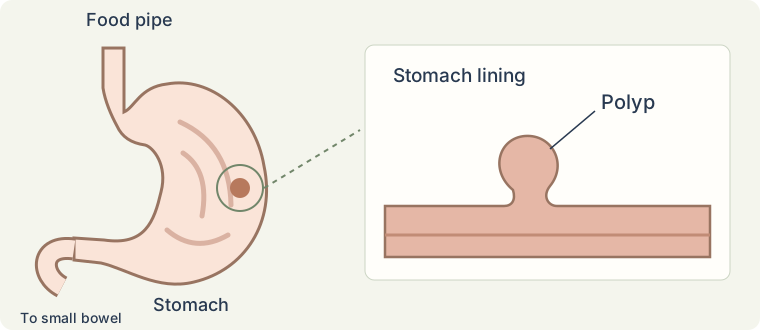
The three main types
| Type | What it usually means | Usual next step |
|---|---|---|
| Fundic gland polyp | Usually small, smooth bumps in the upper stomach. Typical small, non-inherited polyps are benign and have no significant cancer risk. | Typical small polyps can often be left alone. Larger or unusual-looking ones may need a sample or removal. |
| Hyperplastic polyp | An overgrowth often linked to inflammation of the stomach lining. Most are benign, but some contain abnormal cells. | Check the polyp and surrounding lining, including for H. pylori infection. Larger, bleeding or abnormal polyps may need removal. |
| Gastric adenoma | A precancerous growth, unlike a harmless fundic gland polyp. This does not necessarily mean cancer. Stomach adenomas are far less common than adenomas in the colon (large bowel). | Usually remove it completely when safe, check the remaining stomach lining and arrange follow-up gastroscopy. |
These types can occur together. Less common findings, such as neuroendocrine tumours or lumps beneath the lining, need their own assessment.
What do you look for at gastroscopy?
I check the size, number, location and surface of the polyps, as well as the rest of the stomach. A typical fundic gland polyp can often be recognised by its appearance. Other polyps usually need tissue sampling to establish the type.
A biopsy takes a small sample. Polypectomy removes the polyp. The laboratory report describes the tissue and whether there is dysplasia, meaning abnormal cells that can develop towards cancer. Dysplasia is not the same as invasive cancer.
Why wasn't my polyp removed?
Leaving a typical small fundic gland polyp alone is often appropriate. Removing every harmless polyp adds little benefit and introduces a small risk of bleeding or injury.
A larger or more complicated polyp may need a separate appointment for removal, with suitable equipment and preparation. A biopsy first does not mean treatment has been forgotten.
Which findings need closer assessment?
An unusual surface, ulceration, bleeding or a polyp larger than about 1 cm may change the recommendation. Numerous polyps, a young age or a family history of polyposis can also prompt assessment for an inherited condition. These features do not, by themselves, mean cancer.
A short explanation
English narration with English or Chinese subtitles.
Read the video transcript
Most stomach polyps are harmless and do not turn into cancer.
A polyp is a growth on the inner lining, and different types need different care.
Fundic gland polyps are usually small and smooth.
Typical small, non-inherited polyps are benign and have no significant cancer risk.
Typical small polyps can often be left alone, without repeat gastroscopy just for them.
Hyperplastic polyps are often linked to inflammation.
We check the surrounding lining and look for Helicobacter pylori, a treatable infection.
Larger, bleeding or abnormal polyps may need removal.
Gastric adenomas are far less common than adenomas in the colon, or large bowel.
They are precancerous growths, so complete removal and follow-up are usually recommended.
The polyp's size, appearance and tissue results help guide the decision.
Stomach polyps are not managed in exactly the same way as bowel polyps.
If you take a PPI, such as omeprazole, don't stop it just because typical fundic gland polyps were found.
We can discuss whether treatment is still needed.
Your endoscopy report and biopsy results will explain whether you need treatment or another examination.
Did my PPI cause this? Should I stop it?
Fundic gland polyps are often found in people taking acid-suppressing medicines such as omeprazole. They also occur in people who do not take a PPI, so finding them does not prove the medicine caused them.
A useful PPI does not usually need to be stopped because of typical fundic gland polyps. We can review why you take it and whether the dose is still appropriate. Please do not stop prescribed treatment just because the report mentions polyps.
Why take samples from the rest of the stomach?
With hyperplastic polyps or adenomas, the surrounding lining may help explain why the polyp developed. I may check for H. pylori, a treatable stomach infection, and for longer-term changes such as thinning of the lining (atrophy) or intestinal metaplasia.
If H. pylori is found, treatment and a test to confirm it has cleared are usually needed. Some hyperplastic polyps shrink after treatment. Changes in the surrounding lining can influence follow-up even after the polyp has been removed.
Will I need another gastroscopy?
Typical small, non-inherited fundic gland polyps without dysplasia usually need no dedicated surveillance. An adenoma, dysplasia, incomplete removal or concerning changes in the stomach lining may need another examination.
The timing depends on the tissue result and what was removed. Recommended follow-up is recorded in your endoscopy report and/or the letter sent after your biopsy results. If a result is overdue, contact our team.
Are stomach polyps the same as bowel polyps?
No. The name describes a growth, not a single disease. Many bowel adenomas and serrated lesions are removed to prevent bowel cancer. That approach does not mean every stomach polyp needs removal.
A typical fundic gland polyp does not, on its own, mean you need a colonoscopy. Your symptoms, screening eligibility, family history and any features of an inherited polyposis condition are considered separately.
Could the polyps be causing my symptoms?
Small stomach polyps usually cause no symptoms. Reflux, bloating or indigestion should not automatically be attributed to them. A larger polyp can occasionally bleed or interfere with food leaving the stomach.
When to seek help
Seek urgent medical assessment for vomiting blood, new black tar-like stools, fainting or severe or worsening tummy pain, especially after polyp removal. Call 111 if you are seriously unwell.
Contact your GP or our team about persistent vomiting, difficulty swallowing, unexplained weight loss or ongoing symptoms. Follow the individual aftercare instructions from your endoscopy service.
Sources and further reading
- AGA Clinical Practice Update: management of gastric polyps (2026)
- BSG/AUGIS: best practice for upper gastrointestinal endoscopy (2026)
- BSG: gastric polyps and gastric cancer risk guidance (2019)
- ACG: gastric premalignant conditions, including gastric polyps (2025)
- NIDDK: upper gastrointestinal endoscopy and aftercare
- St Vincent's Private Hospitals: gastric polyps
- Carmack et al. Gastric polyps in over 120,000 patients (2009)
- Benchmarking colorectal adenoma detection in the GIQuIC registry (2021)