
Choose tests for symptoms, a scan finding or inherited risk
I first establish why we need to examine the pancreas. Persistent pain, unexplained weight loss or jaundice needs diagnostic assessment. A cyst found by chance needs review of its scan features. Surveillance for inherited risk follows a separate specialist plan.
I review your symptoms, blood results, previous images and family history before recommending a scan or referral. A normal gastroscopy, colonoscopy or FIT does not rule out pancreatic disease. New jaundice needs prompt assessment.
The pancreas is outside the digestive lining
Where it sits
The pancreatic head sits beside the duodenum on your right. The body and tail extend towards your left, mainly behind the stomach. The ducts carry digestive juices into the bowel.
Where it sits
The pancreatic head sits beside the duodenum on your right. The body and tail extend towards your left, mainly behind the stomach. The ducts carry digestive juices into the bowel.
What imaging adds
CT and MRI assess structures beyond the lining seen at routine endoscopy.
Why EUS is different
The probe symbol sits inside the stomach outline. EUS is a separate specialist examination from a routine gastroscopy.
Who needs regular checks?
Symptoms need diagnostic assessment. A well person at average risk does not need routine pancreatic screening. Selected inherited-risk families may have a specialist MRI/MRCP and EUS surveillance plan.
Simplified illustrations, not to scale. These show an example, not your own anatomy or test result.
Read every diagram explanation
Where it sits
The pancreatic head sits beside the duodenum on your right. The body and tail extend towards your left, mainly behind the stomach. The ducts carry digestive juices into the bowel.
What imaging adds
CT and MRI assess structures beyond the lining seen at routine endoscopy.
Why EUS is different
The probe symbol sits inside the stomach outline. EUS is a separate specialist examination from a routine gastroscopy.
Who needs regular checks?
Symptoms need diagnostic assessment. A well person at average risk does not need routine pancreatic screening. Selected inherited-risk families may have a specialist MRI/MRCP and EUS surveillance plan.
Why timely assessment is important
The national report found that about 69 in 100 people in its pancreatic cancer cohort had an acute or unplanned hospital admission shortly before diagnosis. This is a historical description of care, not your chance of cancer. It supports taking persistent changes seriously and following investigations through.
68.7% with a preceding acute admission 31.3% without one recorded
Diagnoses 2015 to 2019. Report published 2023, table 2. This is not 2026 incidence or a personal prognosis. Read the national report.
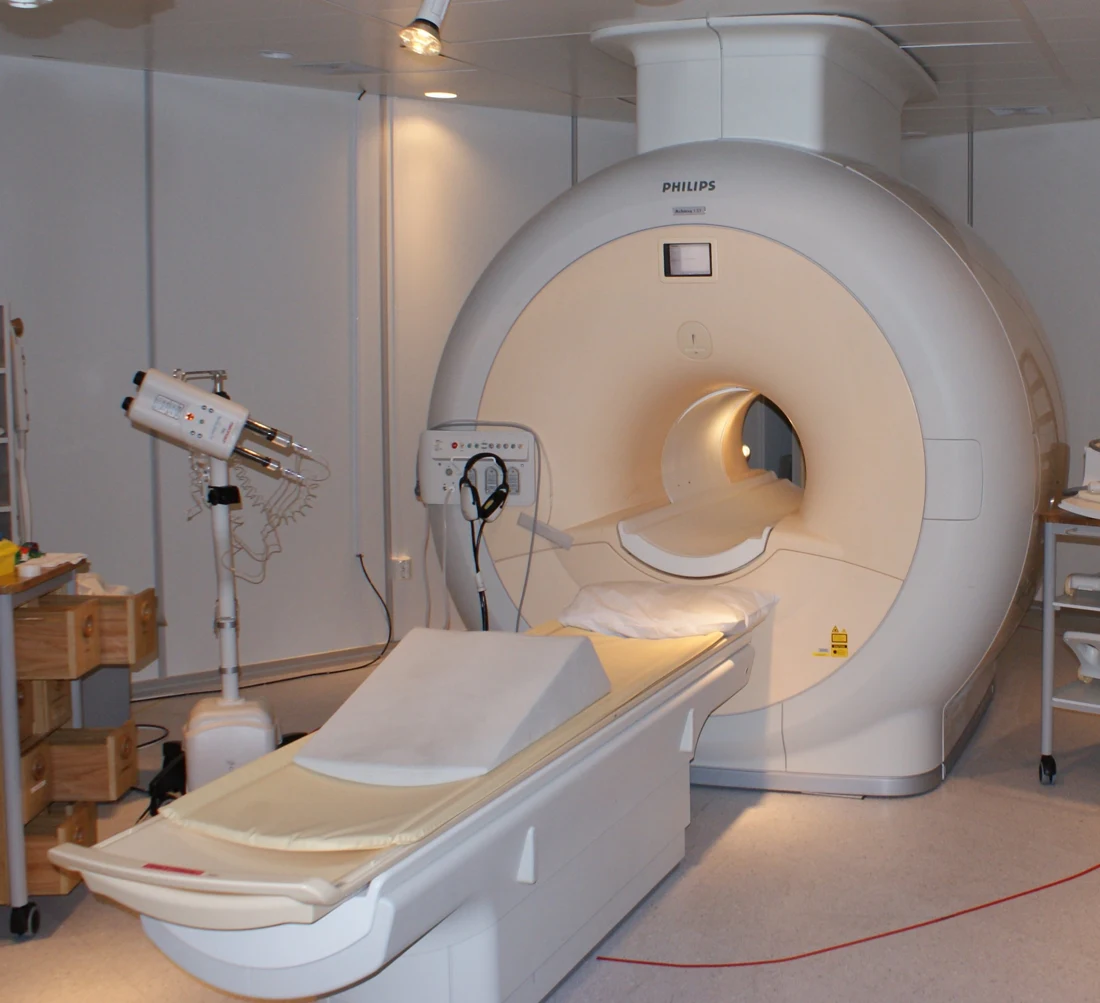
Photograph credit
Jan Ainali, MRI-Philips.JPG, original photograph, CC BY 3.0. Resized and converted to WebP.

What does the pancreas do?
The pancreas makes digestive enzymes that pass through the pancreatic duct into the duodenum, the first part of the small bowel. It also makes hormones, including insulin, which help control blood sugar. Its head sits beside the duodenum on your right, and its body and tail extend towards your left.
Most pancreatic cancers start in the duct cells and are called pancreatic ductal adenocarcinoma. Neuroendocrine tumours are a different group with different behaviour and treatment. This guide mainly concerns ductal adenocarcinoma.
Which symptoms need assessment?
Arrange a review for unexplained weight loss, persistent or worsening upper abdominal pain that may spread to the back, loss of appetite, or pale greasy stools. Yellow eyes or skin, dark urine and unusually pale stools can indicate a blocked bile duct. These changes have several possible causes, including gallstones; they are not a diagnosis of cancer.
New diabetes is usually unrelated to pancreatic cancer. I ask more questions if it occurs with weight loss, abdominal or back pain, or a rapid unexplained change in glucose control. New diabetes on its own does not mean you need a pancreatic scan.
Why screening is not recommended for everyone
For a well person without a strong family history or a relevant inherited condition, routine pancreatic screening is not recommended. Scans can find harmless or uncertain abnormalities and lead to repeated procedures or an operation that was not needed. A normal scan cannot guarantee that cancer will not develop later.
This differs from established bowel screening. A bowel FIT kit looks for blood in poo and does not screen the pancreas. Neither a normal FIT nor a normal colonoscopy rules out a pancreatic condition.
What if pancreatic cancer runs in my family?
Tell me which blood relatives were affected, how they are related to you, their ages at diagnosis and whether anyone has had genetic testing. Bring the actual genetic report if available. One affected relative does not by itself mean annual pancreatic scans are recommended.
Several affected relatives, or a pathogenic gene change associated with pancreatic cancer, may justify genetics and pancreatic specialist assessment. Surveillance can be considered for selected higher-risk people. Eligibility and the starting age depend on the gene, family pattern, health and willingness to undergo treatment if an abnormality is found.
I can arrange a specialist opinion to establish whether surveillance is appropriate and which tests and timing suit your family history or genetic result.
What can each test show?
I may recommend one or more of these tests, depending on the concern. They are not steps that everyone must complete.
| Option | Purpose |
|---|---|
| Pancreas-protocol CT | Assess a suspected tumour, nearby blood vessels and other organs. |
| MRI / MRCP | Examine the pancreas and ducts, including selected cyst or duct findings. |
| Endoscopic ultrasound (EUS) | Obtain close ultrasound views and, when needed, a tissue sample. This is a separate specialist procedure from routine gastroscopy. |
| Abdominal ultrasound | Look for gallstones or bile-duct widening. It cannot reliably exclude a pancreatic problem if bowel gas obscures the pancreas. |
| ERCP | Treat a duct problem, such as relieving a bile-duct blockage. It is not a routine pancreatic screening test. |
Can a blood test check for pancreatic cancer?
There is no routine blood test that reliably screens an otherwise well, average-risk person for pancreatic cancer. CA19-9 is sometimes useful during specialist assessment or follow-up, but can be normal in cancer and raised by non-cancerous bile-duct blockage or inflammation. A normal result cannot rule cancer out.
Commercial tests advertised for early cancer detection should not replace investigation of symptoms or an agreed high-risk surveillance plan. Before paying, ask what the test has been shown to detect, how often it misses disease and what happens after a positive or uncertain result.
What does high-risk surveillance involve?
Specialist surveillance commonly uses MRI/MRCP and EUS, sometimes alternating them. If the examination is reassuring, checks are often yearly, but the programme decides the interval. An abnormality can require an earlier review. Any new symptoms should be assessed when they occur rather than waiting for the next scan.
Surveillance aims to find a small treatable cancer or a high-risk precancerous change. It does not prevent every cancer or guarantee detection before spread. Recent observational studies are encouraging, but they do not establish that population screening would help everyone.
What if a scan finds a pancreatic cyst?
A cyst is a fluid-containing area. Many are found by chance and are not cancer. I review the type, size, duct appearance, any solid area, previous scans and symptoms. Some need no further testing, some need follow-up, and a smaller group need more detailed assessment.
Follow-up for a pancreatic cyst depends on its type and scan features, your symptoms and your general health. I review the complete scan report and any earlier images before recommending another test or a surgical opinion. Screening because of an inherited risk is a separate assessment.
What to bring and what happens next
Bring previous scan reports and, where possible, the images, recent blood results, your medicine list and family cancer history. I check what has already been examined and explain which next test could change the diagnosis or treatment.
If a suspicious abnormality is found, care may involve radiology, endoscopy, pancreatic surgery and oncology. The team coordinates the order of scans, tissue sampling and treatment. It is reasonable to bring a support person and write down your questions.
When to get help
New yellowing of the eyes or skin needs prompt medical assessment, particularly with dark urine or pale stools. Contact your GP or urgent care the same day.
Jaundice with fever or shaking chills, severe pain, confusion or marked illness needs urgent hospital assessment because an infected blocked bile duct is possible. Persistent vomiting or inability to keep fluids down also needs urgent review.
Call 111 if you collapse, become confused or are too unwell to travel safely. Do not wait for a routine appointment or an email reply.
Three things to remember
- Tell me about new symptoms, previous scans and any relatives with pancreatic cancer. These help me choose the appropriate tests.
- Routine pancreatic screening is not recommended for an average-risk person without symptoms.
- A normal gastroscopy, FIT or CA19-9 does not exclude pancreatic disease.
Related information
Sources and further reading
English clinical master checked 16 October 2026.
- Te Aho o Te Kahu: NZ pancreatic cancer pathway (version 2, September 2025)
- Te Aho o Te Kahu: national pancreatic cancer monitoring report (2023, diagnoses 2015 to 2019)
- Cancer Society NZ: pancreatic cancer
- USPSTF: recommendation against average-risk pancreatic screening (2019)
- International CAPS Consortium: high-risk surveillance recommendations (2019 consensus, published 2020)
- ASGE: genetic susceptibility and pancreatic screening (2022)
- AGA: pancreatic screening in high-risk individuals (2020)
- Blackford et al: high-risk pancreatic surveillance comparative cohort (JAMA Oncology, 2024)
- NCI: interpretation and limitations of the 2024 surveillance study
- Auckland laboratory test guide: CA19-9 and its screening limitations
- NIDDK: pancreas function and its location
- MRI equipment photograph: Jan Ainali, CC BY 3.0. Resized and converted to WebP. Taken in Sweden, not at our practices.